Understanding small business utilities is no longer just about paying bills on time. For UK businesses, electricity pricing has become increasingly complex, and the way energy is consumed throughout the day can significantly affect overall costs. One of the most important, yet least understood, factors influencing small business utilities cost is the difference between peak and off-peak energy rates.
Many small business owners focus on unit prices without realising that when energy is used can matter just as much as how much is used. This guide provides a detailed, practical explanation of small business utilities, average costs, and how peak vs off-peak energy pricing works in the UK. The goal is to help business owners make informed decisions, avoid unnecessary costs, and understand their energy bills with confidence.
What are Small Business Utilities?

Small business utilities refer to the essential services required to operate a business on a daily basis. These costs are ongoing, unavoidable, and directly tied to how a business functions. While the mix of utilities varies by sector, energy is almost always the most expensive and volatile component. Understanding how these utilities are priced is the foundation of controlling long-term operating costs.
Unlike domestic utilities, business utilities are rarely standardised. Pricing structures, contracts, and terms can differ significantly, which is why many businesses struggle to calculate their true average small business utility costs or compare suppliers accurately.
Understanding the Core Utilities Every Small Business Pays For
Small businesses typically rely on a core set of utilities to remain operational. These services form part of fixed overheads and often increase as a business grows or extends operating hours.
Key utilities include:
- Electricity for lighting, equipment, and heating
- Gas for heating, cooking, or production
- Water and wastewater services
- Internet and phone connectivity
- Waste collection and recycling
Electricity usually represents the largest share of small business utilities costs, particularly for customer-facing or energy-intensive operations.
Small Business Utilities in the UK: How They Differ from Domestic Supply
In the UK, small business utilities operate under a different regulatory and commercial framework than household utilities. While domestic customers benefit from price caps and default tariffs, business customers are expected to engage actively with the market. This difference alone explains why many small businesses unknowingly pay above-average rates.
Business energy contracts are typically fixed-term agreements with pricing based on risk, usage patterns, and market conditions at the time of signing. As a result, two similar businesses can face very different energy costs.
Why Business Energy Is Priced Differently
Business energy pricing reflects commercial risk rather than consumer protection. Suppliers assess how predictable, flexible, and energy-intensive a business is before offering rates.
Key pricing factors include:
- Annual consumption levels
- Half-hourly or non-half-hourly metering
- Operating hours and load profile
- Contract length and credit risk
These variables mean that small business utilities UK pricing is far more personalised than domestic supply.
Average Cost of Utilities for a Small Business
The average cost of utilities for a small business in the UK varies widely, but electricity almost always represents the largest single expense. Costs can range from a few thousand pounds annually for small offices to tens of thousands for hospitality or retail businesses. Understanding averages is useful, but only when combined with usage context.
Many businesses underestimate costs by focusing on unit rates alone, without accounting for standing charges, peak pricing, or inefficient usage patterns.
What Influences Average Small Business Utility Costs
Utility costs are shaped by how a business operates rather than its size alone. Two businesses of similar square footage can have very different bills depending on behaviour and equipment.
The most common influences are:
- Opening hours and peak-time usage
- Energy-intensive machinery or appliances
- Seasonal demand changes
- Tariff structure and standing charges
These factors explain why average small business utility costs should be treated as guidance, not benchmarks.
Understanding Energy Rates for Small Businesses

Energy rates determine how much a business pays per unit of electricity or gas. However, rates are not just about price per kilowatt-hour — they are part of a broader pricing structure that includes time-based charges and fixed fees. Understanding how these rates work is essential for managing small business utilities costs effectively.
Energy rates are influenced by wholesale markets, grid demand, and supplier risk models, which means prices fluctuate more frequently for businesses than for households.
What Makes Up a Business Energy Rate
A business energy bill usually includes multiple pricing components that together determine the total cost. Focusing on just one element can lead to poor decisions.
Energy rates typically include:
- Unit rate (pence per kWh)
- Standing charge (daily fixed cost)
- Time-of-use pricing (if applicable)
Time-of-use pricing is where peak vs off-peak energy rates become relevant.
What are Peak vs Off-Peak Energy Rates?
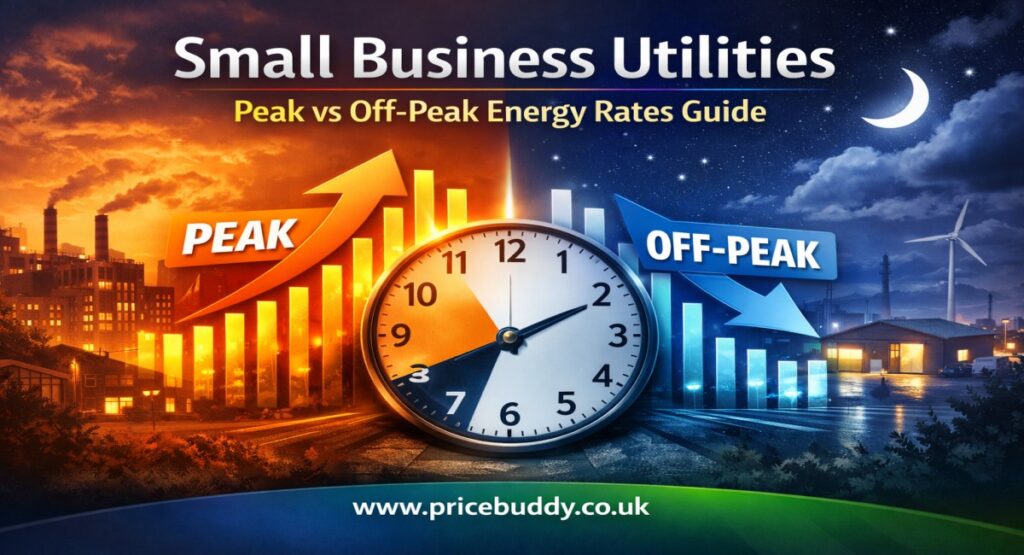
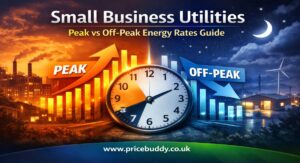
Peak vs off-peak energy rates are designed to reflect demand on the electricity grid. When demand is high, energy costs more. When demand is lower, prices fall. This pricing model encourages businesses to shift consumption away from busy periods, helping balance the grid.
For businesses, this pricing structure can either reduce or increase total costs depending entirely on when energy is used.
Peak vs Off-Peak Energy Explained Simply
Peak energy refers to periods when electricity demand is highest, usually during standard working hours. Off-peak energy applies when fewer users are drawing power from the grid.
In practical terms:
- Peak energy costs more per unit
- Off-peak energy is cheaper but time-restricted
- Businesses pay different rates depending on usage timing
Understanding peak vs off-peak energy is critical for accurate cost forecasting.
Peak vs Off-Peak Energy Rates in the UK
In the UK, peak and off-peak periods vary by supplier and meter type, but general patterns apply. These rates are most visible for businesses with half-hourly meters, where usage is tracked throughout the day.
Without understanding these time windows, businesses may unknowingly concentrate usage during the most expensive periods.
Typical Peak and Off-Peak Time Windows
While exact times vary, most UK suppliers follow similar demand patterns.
Common examples include:
- Peak: weekday mornings and early evenings
- Off-peak: overnight hours
- Shoulder periods with mid-range pricing
Knowing your peak vs off-peak energy rate structure is essential before choosing a tariff.
How Peak vs Off-Peak Energy Rates Affect Small Business Utilities

Peak pricing directly affects small business utilities costs by increasing the price of electricity during the hours most businesses operate. For some businesses, this structure aligns well with their workflow. For others, it creates higher bills despite lower off-peak prices.
The key factor is whether energy use can be shifted without disrupting operations.
Which Businesses Benefit from Off-Peak Energy Rates
Off-peak tariffs are most suitable for businesses with flexible or extended operating hours. These businesses can take advantage of cheaper rates without major changes.
Examples include:
- Manufacturing and production facilities
- Bakeries and food prep businesses
- Cold storage and logistics
- EV charging operations
For these businesses, off-peak pricing can reduce average small business utility costs significantly.
When Peak Rates Increase Small Business Utility Costs
For many SMEs, peak pricing has the opposite effect. Businesses operating mainly during standard office hours often see higher overall bills on time-of-use tariffs.
This is especially true when:
- Most consumption occurs during peak windows
- Equipment runs continuously throughout the day
- There is limited ability to shift usage
In these cases, a single-rate tariff may be more cost-effective.
Hidden Costs Within Small Business Utilities
Many businesses underestimate their utility costs because they focus only on headline rates. In reality, additional charges and contract terms often have a larger long-term impact.
Understanding these hidden costs is essential for controlling small business utilities spend.
Standing Charges and Contract Structures
Standing charges apply regardless of usage and can significantly affect smaller businesses. Longer contracts may reduce unit rates but increase fixed costs.
Hidden cost factors include:
- High standing charges
- Automatic rollover contracts
- Early termination fees
These costs quietly inflate small business utility costs over time.
Managing Small Business Utility Costs Effectively
Reducing utility costs does not always require a major investment. In many cases, better visibility and small operational changes can deliver meaningful savings.
The most successful businesses treat utilities as an ongoing management task, not a one-off contract decision.
Monitoring and Analysing Energy Usage
Usage data provides insight into when and how energy is consumed. Smart meters and half-hourly data make it easier to identify inefficiencies.
Monitoring helps businesses:
- Identify peak usage periods
- Spot abnormal consumption
- Align tariffs with behaviour
This information is crucial when assessing peak vs off-peak energy rates.
The Role of Energy Consultants in Small Business Utilities
Energy consultants help businesses interpret complex tariffs and usage data. Their role is not to reduce consumption directly, but to improve decision-making around contracts and pricing structures.
For businesses without internal expertise, consultants can provide clarity and confidence.
How Consultants Support Better Utility Decisions
Energy consultants typically focus on analysis rather than supply.
They may assist with:
- Reviewing usage profiles
- Explaining tariff suitability
- Comparing energy rates objectively
This support helps businesses avoid unsuitable contracts.
FAQs
What is the Average Cost of Utilities for a Small Business in the UK?
The average cost of utilities for a small business depends on industry, size, and operating hours. Electricity is usually the highest cost, with wide variation based on usage patterns and tariff structure.
Is Peak vs Off-Peak Energy Cheaper for Small Businesses?
It depends entirely on when energy is used. Businesses that operate mainly during peak hours may pay more overall, even with lower off-peak rates.
How Often Should Small Business Utility Contracts Be Reviewed?
Contracts should be reviewed at least annually and before renewal to avoid rollover rates and ensure tariffs still suit the business.
Can an Energy Consultant Like PriceBuddy Help with Small Business Utilities?
Some businesses choose to work with energy consultants such as PriceBuddy to better understand their small business utilities, usage data, and whether peak vs off-peak energy rates are appropriate. This typically involves analysis and guidance rather than direct energy supply.
Conclusion
Managing small business utilities effectively requires more than choosing the lowest advertised rate. Understanding how energy rates work, particularly peak vs off-peak energy rates, is essential for controlling long-term costs.
For UK businesses, the biggest savings often come from aligning tariffs with actual usage patterns rather than chasing headline prices. Some businesses manage this internally, while others seek insight from energy specialists such as PriceBuddy to better understand their options.
Ultimately, informed decision-making, regular reviews, and a clear understanding of energy usage are the most reliable ways to reduce small business utility costs and avoid unnecessary expense.